

"I followed the instructions perfectly, but unfortunately the Deep Pour Epoxy I received cured improperly and I encountered multiple cracks and imperfections."
— Verified Bond Craftor customer, river table projectSound familiar? Here's the thing that makes this problem so maddening: you did everything right. You proved the technique worked on a smaller project. You followed the product instructions. And then the large pour cracked anyway.
The instructions didn't lie to you. But they also didn't tell you the full story — because the rules change when the surface area scales up. This guide explains the real physics behind why large river tables behave completely differently from small ones, and gives you the exact numbers to make sure it never happens again.
The Real Reason Size Changes Everything: Heat Math
Here's the core problem that almost nobody explains: epoxy resin generates heat as it cures. This is called an exothermic reaction, and it happens with every pour, every time. On a small piece, that heat dissipates harmlessly. On a large piece, it builds up — and that's when things go wrong.
The reason your small test piece succeeded is the same reason your large table cracked. Let's look at the numbers.
Same 2-inch pour depth — completely different heat outcome
✓ Small test piece (12" × 12")
~1 lb
Resin mass per layer. Heat dissipates quickly through sides and surface. Peak temperature stays manageable. Cures cleanly.
✗ Large river table (24" × 72")
~18 lbs
Same depth, 18× the resin mass. Heat has nowhere to go. Internal temperature can spike 50°F+ above ambient. Cracking is almost inevitable.
This is the part nobody tells you: heat doesn't scale linearly with area — it compounds. Double the surface area and you get far more than double the accumulated heat, because the ratio of heat-generating volume to heat-escaping surface area gets worse as the piece gets larger.
This is why the same technique, same product, same pour depth that worked perfectly on your test piece can destroy a large river table. You weren't doing anything wrong. You just hit the physics wall that exists for every deep pour epoxy on the market.
The 6 sq ft threshold. Industry experience shows that projects over 6 square feet (roughly 24" × 36") are where exothermic heat buildup becomes a serious risk for deep pours. Beyond this size, the standard pour depth limits on product labels are no longer sufficient — you need to reduce thickness per layer and let each layer cool before adding the next.

What "Cracking From Heat" Actually Looks Like
Not all epoxy failures look the same. Knowing which type you're dealing with tells you exactly what went wrong.
Type 1: Center crack running lengthwise
A single crack running along the middle of the epoxy channel — often with smaller radiating cracks branching out from it. This is the signature of exothermic overheating: the center of a large pour reaches peak temperature first, expands, then contracts faster than the outer edges as it cools, creating a tension fracture down the middle.
Type 2: Cloudy white surface or milky patches
White haze, milky areas, or a frosted look that wasn't there during the pour. This is almost always moisture contamination — high ambient humidity (above 85% RH), condensation from cold surfaces, or outdoor overnight curing where dew forms on the surface before the epoxy has fully set.
"Also, please avoid mixing a very large amount of epoxy at one time, especially in warmer weather. It is safer to pour in multiple thinner layers and allow each layer to cool and partially cure before adding the next one." — Bond Craftor Customer Support, responding to a large river table failure
Type 3: Cracks along the wood-epoxy seam
Clean separations running exactly along the boundary between wood and resin. This is wood movement — the wood slab had too much residual moisture and continued to shrink after the rigid epoxy locked around it. The epoxy wins the tug-of-war every time, and the seam is where something has to give.

Why Large River Tables Crack: 5 Causes
Most common — especially on large pours
You Poured Too Much in One Shot for the Surface Area
This is the failure mode that catches experienced makers off guard. They've poured that depth before on a small piece — it worked. So they scale up the project and use the same depth. The result is catastrophic cracking, sometimes within hours of the pour, sometimes even audible as loud snapping sounds.
"I poured 4 inches in one shot, it literally smoked and cracked down the middle." — Reddit r/woodworking, high-engagement comment
What's happening: on a large project, the sheer mass of resin generates more heat than the surface area can dissipate. Internal temperatures can spike far above ambient, creating differential stress between the hot interior and cooler surface. The resin cracks from the inside out.
Fix
- For projects over 6 sq ft, cut the maximum pour depth in half compared to the product spec
- Pour the first layer, let it reach initial cure (tacky but firm), then add the next
- Never mix more than you can immediately spread — resin sitting in a bucket generates heat faster than resin spread across a mold
- In warm weather (77°F+), reduce layer thickness further — see the reference table below
Outdoor curing risk
High Humidity or Overnight Dew Turned It Cloudy
Outdoor pours are tempting — more space, better ventilation, easier cleanup. But leaving an uncured or partially cured river table outside overnight is one of the most reliable ways to end up with a cloudy, whitened surface that no amount of sanding fully fixes.
Epoxy is hygroscopic during cure — it actively absorbs moisture from the air. When ambient humidity climbs above 85% RH, or when overnight temperatures drop enough for dew to form on the surface, water molecules become trapped in the resin matrix. The result is that characteristic milky-white haze.

Fix
- Always cure indoors, or in a covered space with controlled humidity
- Keep ambient humidity below 85% RH for the full cure period
- If you must work outdoors, bring the piece inside before sunset — temperature drops sharply after dark and dew forms fast
- Cover the pour with a tent or cardboard box to block airborne moisture — never use plastic sheeting in contact with the surface
Often discovered 2–6 months later
The Wood Wasn't Dry Enough — And Kept Moving
This failure mode is cruel because it doesn't show up immediately. The pour looks perfect. The table is beautiful. Then two months later, a clean crack appears running exactly along the wood-epoxy seam.
"I spent 3 weeks on this table and it cracked along the wood-epoxy seam 2 months later. Turns out my slab wasn't dry enough." — Reddit r/woodworking, typical long-form failure post
Wood with residual moisture above 12% will continue to shrink as it acclimates. Epoxy is rigid and doesn't move. The wood keeps shrinking, the epoxy stays fixed, and eventually the seam — the weakest point in the system — gives way.
Fix
- Wood moisture content must be below 8–12% before pouring — measure with a wood moisture meter, don't guess
- Acclimate your slab in the same indoor environment where the finished table will live, for at least 2 weeks before pouring
- Store the finished table away from direct sunlight and HVAC vents — rapid temperature cycling accelerates wood movement
Garage / outdoor overnight curing
Temperature Dropped During the Cure — More Than 15°F
If the temperature swings more than about 15°F (8°C) while your epoxy is curing, the top and bottom of the pour cool and contract at different rates. The resulting differential stress finds the path of least resistance — usually a crack running through the pour.
"I left it in the garage overnight, temperature dropped 30°F, woke up to a cracked table." — Common user description across Reddit and Facebook DIY groups
Fix
- Maintain a stable temperature between 70–85°F (21–29°C) for the full cure period
- Don't cure in a garage, basement, or any space where temperature drops significantly at night
- Keep air conditioning and heating vents from blowing directly on the curing surface
- In hot climates (Arizona, Florida summers), reduce pour depth and consider early morning pours when ambient temperature is lowest
Impatience is expensive
You Demoulded or Flipped It Before It Was Ready
Deep pour epoxy has two very different milestones: initial cure (surface feels hard, maybe 24–48 hours) and full cure (the interior is completely hardened, 50–168 hours depending on depth and temperature). These are not the same thing.
Demoulding, flipping, or sanding at the 24-hour mark feels safe — the surface is solid. But the interior can still be soft, especially on thick large pours. The hard shell can't support the stress of handling, and cracks appear that look inexplicable because the outside felt completely cured.
Fix
- Initial cure (demould-safe): minimum 50 hours for Bond Craftor 2–4 Inch Casting
- Full cure (safe to sand/machine): minimum 168 hours (7 days)
- The touch test is not reliable — a surface can feel hard while the center is still soft. Always wait the full time.
- Thicker pours and cooler temperatures extend cure time — when in doubt, add 24 hours
The Pour Thickness Reference Table
This is the data that most product pages bury or leave out entirely. Here are the exact maximum pour depths by temperature for Bond Craftor two deep pour formulas — and what changes when you're working on a large project.
| Product | Ambient Temp | Standard Projects | Large Tables (6+ sq ft) | Notes |
|---|---|---|---|---|
|
2–4 Inch Casting Deep Pour |
64.4°F / 18°C (room temp) |
4 inches / 10cm ✓ Full depth | Reduce appropriately ⚠ Scale down | Measured indoor ambient — not AC set temperature |
|
2–4 Inch Casting Deep Pour |
77–89.6°F / 25–32°C (warm conditions) |
2 inches / 5cm ⚠ Reduced | Reduce further ⚠ Scale down | Heat risk significantly higher in warm weather |
|
4 Inch Casting Deep Pour |
64.4°F / 18°C (room temp) |
5 inches / 12.7cm ✓ Full depth | 4 inches max / 10cm ⚠ Reduce | Best choice for large projects at room temperature |
|
4 Inch Casting Deep Pour |
77–89.6°F / 25–32°C (warm conditions) |
~3 inches / 7.6cm ⚠ Reduced | ~1.18 inches / 3cm ⚠ Scale down | Better warm-weather performance than 2–4 Inch Casting |
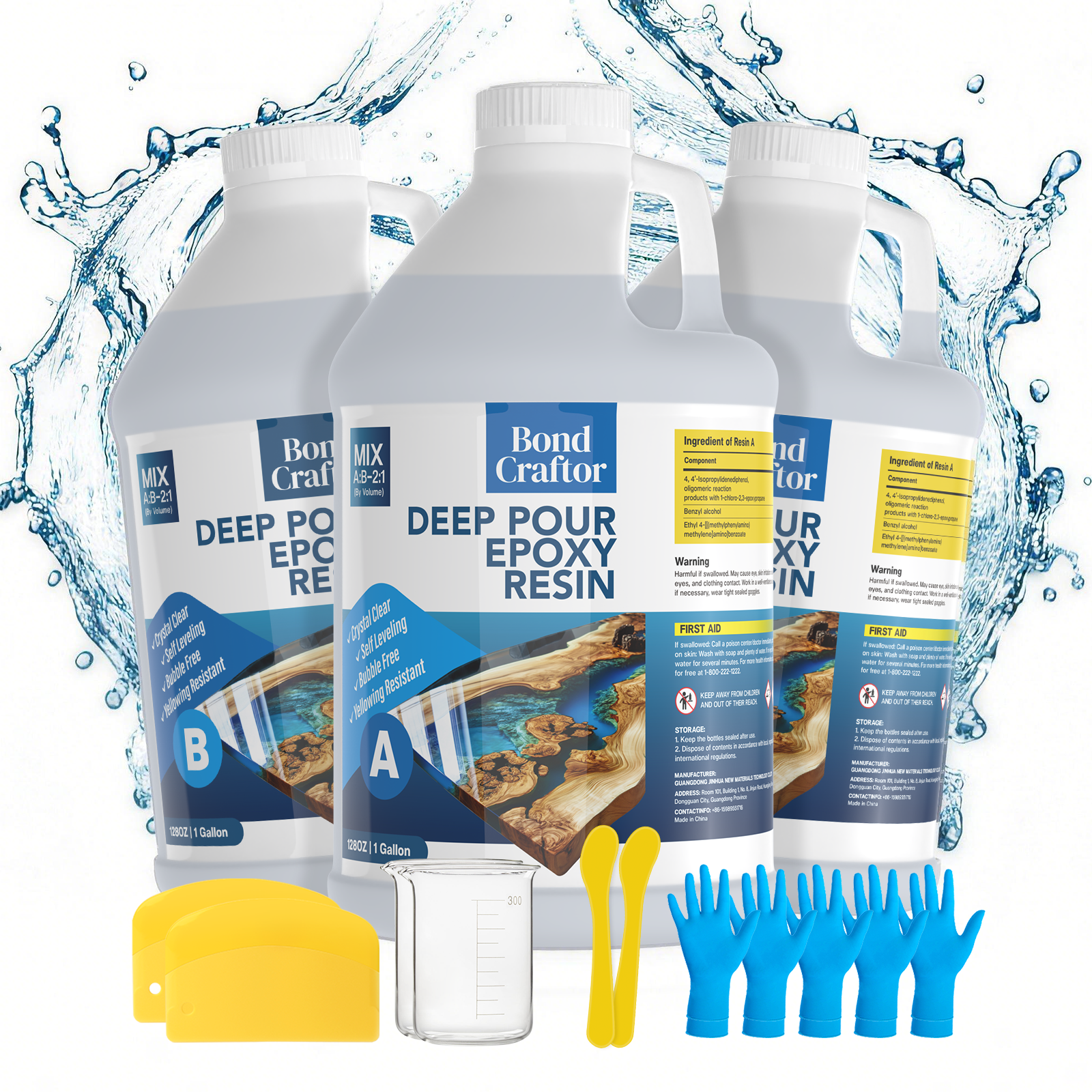
Large table = anything over 6 sq ft (e.g. 24" × 36" or larger). Below this size, standard product depth limits apply. Above it, reduce pour depth per layer and allow extra cooling time between layers. When ambient temperature is above 77°F, the 4 Inch Casting New Formula is the better choice for large river tables — it handles warm conditions with a thicker allowable pour (~1.18 inches vs less for the 2–4 Inch Casting).

Before Your Next Large Pour — The 7-Point Checklist
Run through this before mixing anything. Every item on this list represents a real failure mode that's destroyed real projects.
Pre-Pour Safety Checklist — Large River Tables
-
Measure ambient temperature. If it's above 77°F, use the 4 Inch Casting formula and reduce pour depth. Never pour at above 90°F without significant depth reduction.
-
Check wood moisture content. Must be below 12% — use a moisture meter. Don't trust a dealer's word or visual inspection alone.
-
Confirm you're indoors or in a covered space. Humidity below 85% RH. Temperature will stay stable for the next 50+ hours.
-
Calculate your project area. Over 6 sq ft? Reduce your layer depth from the product spec. Large surface area = more heat accumulation.
-
Plan your layers before you mix. Know how many pours you need, and allow each layer to reach initial cure before adding the next. Don't improvise mid-project.
-
Mix only what you can immediately use. Resin sitting in a bucket gets hotter than resin spread in a mold. Mix, pour, spread — don't let it sit.
-
Block out 7 full days before touching it. Initial cure ≠ full cure. No demoulding, sanding, or machining until 168 hours have passed.
Frequently Asked Questions
Can I save a cracked river table — or is it a total loss?
Sometimes, yes — it depends on the type and severity of the crack. Surface cracks that don't penetrate fully through the epoxy can sometimes be filled with fresh resin, sanded flat, and refinished. Deep structural cracks that go all the way through, or cracks along the wood-epoxy seam, are much harder to fix invisibly.
One of our customers who experienced this failure salvaged the project by carefully breaking down the slab, recovering usable wood sections, and starting fresh with a smaller piece — with better results the second time. Sometimes the most honest answer is: use what you can save, and apply what you learned.
Why did I hear cracking or popping sounds during or after the pour?
Audible cracking is one of the clearest signs of exothermic overheating. When the internal temperature of a large epoxy mass spikes dramatically, the differential expansion between the hot interior and cooler exterior creates enough stress to fracture the resin — and you can hear it happen. If you hear this, the pour has already failed. Do not add more epoxy on top; let it fully cure, assess the damage, and plan your next steps from there.
How do I know if my wood moisture is too high before I pour?
The only reliable method is a wood moisture meter — a handheld device that measures moisture content by driving two pins into the wood. They're inexpensive (under $30) and completely worth it for any river table project. You're looking for a reading below 12%, ideally closer to 8–10% for slabs that will be used in climate-controlled indoor spaces. Don't rely on how the wood looks, feels, or what the supplier tells you — measure it yourself.
What's the difference between deep pour epoxy and table top epoxy for large projects?
Deep pour epoxy is specifically formulated with a slower, lower-heat cure reaction — this is what allows it to be poured thick without catastrophic overheating. Table top epoxy is designed for thin coats (typically under 1/4 inch) and has a faster, hotter cure that would be dangerous in the depths required for a river table. For any pour over about 1/2 inch, always use a dedicated deep pour formula. Mixing them up is one of the most common reasons first-time river table makers end up with failed pours.
My pour turned white and cloudy — is that fixable?
Mild surface cloudiness caused by humidity can sometimes be improved by sanding progressively through grits (80 → 120 → 220 → 400) and finishing with a polishing compound. However, cloudiness that penetrates deep into the pour — where moisture was trapped in the resin matrix during curing — cannot be fully reversed. The best approach is prevention: cure indoors, control humidity, and never leave an open pour outside overnight.
Here's the truth about large river tables: they're genuinely harder than small ones. Not because the technique is different, but because the physics change in ways that aren't obvious until something goes wrong. Every experienced maker has a failed pour in their history.
The customer who sent us those cracked table photos? They wrote back: "I'll salvage what I can from the existing slab and use another board I have. I'll make sure to avoid overheating next time." — and with the pour depth table above, the next one will come out exactly right.
You know something now that most people only learn the hard way. That's worth something.
Bond Craftor Deep Pour Epoxy
The Right Formula for Large River Tables
The 4 Inch Casting New Formula handles warm-weather pours better — ~1.18 inches per layer at 77–90°F, designed specifically for large tabletop projects. Published specs, transparent pour limits.